
A guide to evaluating RPO for your company.
I’ve written about the recruiting process outsourcing (RPO) industry before, but I’m going to try to explain it from scratch. In this article, I’ll define what RPO is and isn’t, describe how companies use it, and help you decide if it’s right for your organization.
First, a definition of RPO:
RPO Definition
Recruiting process outsourcing involves transferring the delivery or ownership of recruitment functions to an external partner. This can cover some or all facets of the recruitment function, including sourcing, screening, assessments, interviewing, candidate evaluation, hiring decisions, onboarding, and retention efforts. It can be used for some or all of a company’s hiring needs, including long-term work or a bounded project. The scope of RPO can vary widely — some companies outsource only part of their recruitment function, while others outsource all of it.
This is the most common way people talk about RPO. But in reality, there are many different ways that companies use RPO. Some companies outsource only parts of their recruitment function; others outsource all of it. Some outsource all their recruitment for certain roles or job categories; others outsource all their recruitment for specific projects. And so on.
The core operating model of RPO is that the provider supplies people, process design, recruiting operations, advisory work, and often technology, rather than being only an applicant tracking subscription.
Typical RPO Components
Here’s what RPO typically includes:
People: People to perform sourcing, screening, interviews, etc.
Process design: Designing processes to make sourcing, screening, etc., more efficient
Recruiting operations: Actually doing sourcing, screening, interviews, etc.
Advisory work: Helping with talent strategy, employer branding, etc.
Technology: Software tools to support the above functions
This is much broader than simply having an applicant tracking system (ATS). While an ATS is useful for tracking the hiring process, it doesn’t do anything to own sourcing, screening, recruiting operations, or even hiring-program design by itself. So just because you have an ATS, you don’t necessarily have an RPO solution.
RPO Versus ATS Software
So how does RPO compare to internal recruiting plus an ATS? Here are some key differences:
Software tracks hiring, but does not own sourcing, screening, recruiting operations, or hiring-program design by itself
ATS: An application that helps track applicants through the hiring process
HRIS integration: Ability to integrate with other HR systems
Sourcing: Finding potential candidates
Screening: Evaluating candidates
Recruiting operations: Doing the actual hiring
Talent pipelines: Building relationships with potential candidates
In short, software helps manage the hiring process, but it doesn’t replace the need for human recruiters.
Common RPO Service Models
There are several common service models that companies use when they outsource their recruitment function. Each has its own strengths and weaknesses, and each may be better suited for certain types of hiring needs. Here’s a brief overview of each model:
Full-cycle RPO: Full-service RPO where the provider owns all aspects of the hiring process, from requisition to onboarding
Project RPO: RPO for a specific initiative or project
Seasonal peaks: RPO during times of high hiring demand
Special hiring projects: RPO for a specific hiring goal
Niche positions: RPO for specialized roles
Modular RPO: RPO for specific components of the hiring process
High-volume RPO: RPO for large-scale hiring initiatives
Blended RPO: A combination of RPO and internal recruitment
Internal recruiters: Internal recruiters who work alongside RPO providers
Each of these models has its own advantages and disadvantages, and which one is best for your company will depend on your specific needs and circumstances.
RPO Versus Staffing and Recruiters
Staffing agencies and contingency recruiters more often provide temporary, contract, or temp-to-perm workers, whereas RPO more often supports permanent hiring. Staffing agencies generally source, pre-screen, and introduce candidates, then hand off to the hiring manager, whereas full-service RPO can manage sourcing, screening, assessment, interviewing, and even onboarding. Contingency recruiters are similar to staffing agencies in that they tend to work transactionally, filling individual requisitions rather than owning the broader recruitment process.
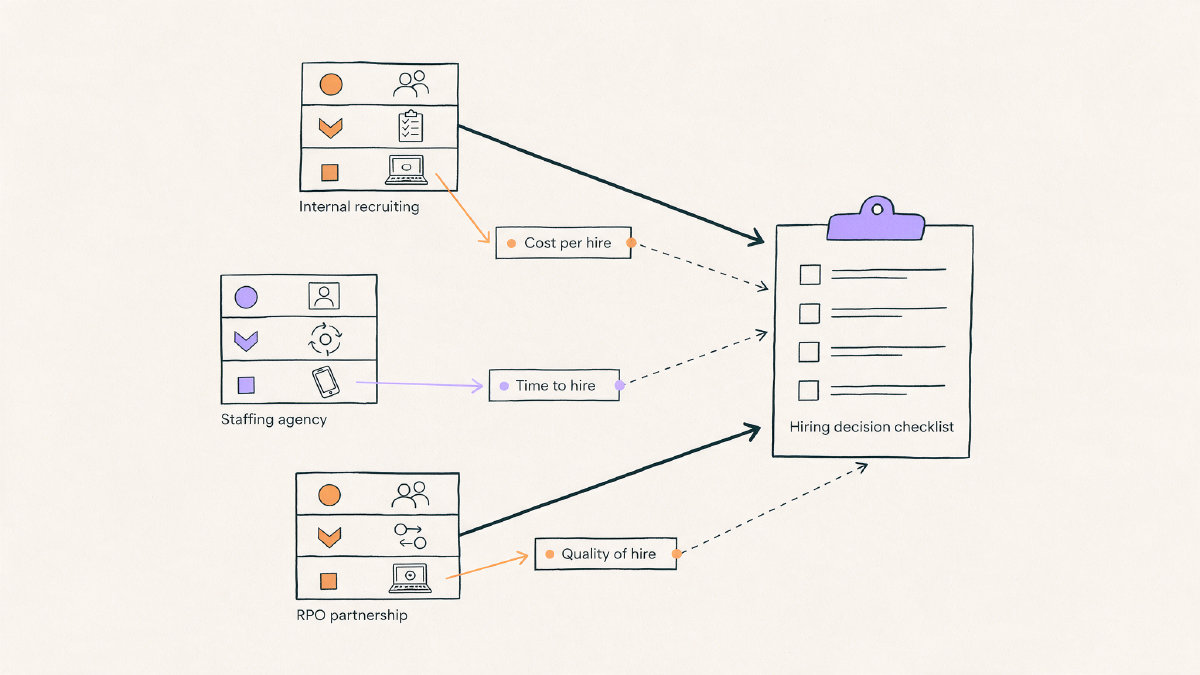
Another difference between RPO and staffing agencies and contingency recruiters is strategic scope. RPO is usually a longer-term engagement, whereas staffing agencies and contingency recruiters are more transactional in nature. RPO is also more likely to involve a strategic partnership with the client company, whereas staffing agencies and contingency recruiters are more likely to be seen as a temporary solution.
Finally, staffing agencies and contingency recruiters are more likely to place temporary workers, whereas RPO is more likely to place permanent employees. Staffing agencies and contingency recruiters are also more likely to charge per hire, whereas RPO is more likely to charge per resource.
RPO Versus MSP and BPO
MSPs and BPOs are both forms of outsourced services, but they’re very different in terms of what they do. MSPs are typically focused on managing contingent workforce programs, including staffing vendors, contractors, payroll, procurement, reporting, and compliance. BPOs, on the other hand, are typically focused on providing business process outsourcing services, such as customer service, marketing, and accounting. RPO is a recruitment-specific form of business process outsourcing. It’s focused on talent acquisition, though full-service RPO can extend through onboarding as part of the recruiting lifecycle.
When evaluating whether RPO is a good fit for your company, there are a few organizational conditions that you should consider. First, you should evaluate whether you have limited bandwidth within your hiring team. If your hiring team is already stretched thin, then outsourcing some or all of your recruitment function could free up time and resources for other important tasks.
Second, you should evaluate whether you have decentralized or inefficient hiring processes. If your hiring processes are slow or inefficient, then outsourcing some or all of your recruitment function could help streamline those processes and improve your overall hiring performance.
Third, you should evaluate whether you have seasonal hiring demands. If you know that you’ll need to hire a lot of people at certain times of the year, then outsourcing some or all of your recruitment function could help you meet those demands more efficiently.
Fourth, you should evaluate whether you have compliance risks. If you’re hiring in a regulated industry, then outsourcing some or all of your recruitment function could help you reduce your compliance risk.
Fifth, you should evaluate whether you have high recruitment costs. If your recruitment costs are high, then outsourcing some or all of your recruitment function could help you save money.
Sixth, you should evaluate whether you lack specialized expertise. If you don’t have the in-house expertise needed to run your recruitment function effectively, then outsourcing some or all of your recruitment function could help you get the results you need.
Seventh, you should evaluate whether you’re growing organically. If you’re growing rapidly, then outsourcing some or all of your recruitment function could help you keep up with your hiring needs.
Eighth, you should evaluate whether you’re undergoing mergers, acquisitions, or expansions. If you’re acquiring another company, then outsourcing some or all of your recruitment function could help you integrate that company’s workforce into yours more smoothly.
Ninth, you should evaluate whether you have weak data and reporting capabilities. If you don’t have the ability to collect and analyze data about your hiring process, then outsourcing some or all of your recruitment function could help you improve your decision-making.
Tenth, you should evaluate whether you have limited functionality in your ATS. If your ATS is outdated or lacks key features, then outsourcing some or all of your recruitment function could help you improve your hiring performance.
These are just a few of the factors you should consider when evaluating whether RPO is a good fit for your company. Ultimately, you’ll need to make a decision based on your unique circumstances and needs.
Pricing and Provider Evaluation
When evaluating RPO providers, buyers are likely to encounter a variety of pricing categories. These include cost-per-hire, fixed cost per hire by position level, cost-per-resource, fixed monthly rate per assigned resource, and management fee. There are also transaction-based pricing models, interview charges, background-check charges, pay-for-performance pricing, hybrid pricing, blended pricing, and true-up pricing. Buyers should also consider the impact of scope, volume, roles, geography, timing, technology, and ancillary fees on total cost.
It’s important to note that benchmark rates or unsupported percentage figures aren’t provided here. Instead, buyers should look for pricing models that align with their organization’s needs and budget. For example, a company looking to outsource a small number of hires might prefer a cost-per-hire model, while a company looking to outsource a large number of hires might prefer a fixed monthly rate model. Additionally, buyers should consider the impact of various factors on total cost, such as scope, volume, roles, geography, timing, technology, and ancillary fees.
When considering RPO, buyers should weigh the likely benefits and tradeoffs. Some of the potential benefits of RPO include scalable capacity, process standardization, technology, analytics, candidate experience, broader talent pools, and faster hiring. However, there are also potential tradeoffs, such as less pricing flexibility, higher rates possible, staffing instability possible, provider fit, and measurable management. Buyers should consider these factors carefully before making a decision.
In addition to the benefits and tradeoffs of RPO, buyers should also consider the pricing models available. There are a variety of pricing models that companies can use when outsourcing their recruitment function. These include cost-per-hire, fixed cost per hire by position level, cost-per-resource, fixed monthly rate per assigned resource, and management fee. There are also transaction-based pricing models, interview charges, background-check charges, pay-for-performance pricing, hybrid pricing, blended pricing, and true-up pricing. Buyers should choose a pricing model that aligns with their organization’s needs and budget.
When choosing an RPO provider, buyers should also consider the impact of various factors on total cost. These include scope, volume, roles, geography, timing, technology, and ancillary fees. Buyers should look for pricing models that take these factors into account and that offer flexibility in pricing. Additionally, buyers should consider the potential for cost savings when outsourcing their recruitment function. For example, outsourcing recruitment could allow companies to reduce their overhead costs, as well as improve their hiring performance.
Ultimately, buyers should choose an RPO provider that offers a pricing model that aligns with their organization’s needs and budget. They should also consider the impact of various factors on total cost, as well as the potential for cost savings when outsourcing their recruitment function.
When evaluating an RPO provider, buyers should look for a provider-evaluation framework that covers the following areas:
Fit: Does the provider have the skills and experience necessary to deliver the desired outcome?
Operating flexibility: Can the provider adapt to changing business needs?
Technology: Does the provider have the technology infrastructure necessary to deliver the desired outcome?
Advisory depth: How deeply involved will the provider be in the hiring process?
Customization: Will the provider tailor its services to meet the specific needs of the company?
Culture: Does the provider share the same values and culture as the company?
Evidence: What evidence does the provider have of its success?
References: Who else has worked with the provider?
Data protection: How will the provider protect the company’s data, and what security capabilities does it use?
ATS and HRIS integration: Will the provider connect recruiting technology with your existing systems?
Talent management and organizational consulting: Can the provider support broader talent strategy and organizational advice?
Scalability and engagement flexibility: Can the provider scale up or down and change the engagement as needs shift?
By evaluating a provider using this framework, buyers can ensure that they select the best provider for their organization.
When defining and reviewing RPO performance, it’s important to use context-specific measures. While speed, cost, retention, and diversity are often cited as the main goals of RPO, these metrics can be misleading. Instead, employers should focus on measuring outcomes that are relevant to their organization’s specific needs. Common RPO KPIs include time-to-fill, quality of hire, cost-per-hire, and hiring manager satisfaction, with clear targets and regular reporting. For example, a company that is struggling with a shortage of qualified candidates might want to measure how many candidates are sourced by the RPO provider, while a company that is looking to improve retention might want to measure how many new hires stay with the company after a certain period of time.
In addition to measuring outcomes, employers should also review RPO performance on a regular basis. This can be done through periodic reviews of performance reports, as well as through direct communication with the RPO provider. Employers should also be sure to document any changes in performance, as well as any actions taken to address any issues.
Ultimately, the goal of reviewing RPO performance is to ensure that the RPO provider is delivering the desired outcomes. By using context-specific measures and reviewing performance on a regular basis, employers can ensure that they are getting the most value from their RPO investment.
When it comes to RPO, there are a few responsibilities that remain with the employer. First, the employer must define and communicate their hiring goals to the RPO provider. This includes identifying the roles that need to be filled, the qualifications required for those roles, and the timeline for filling those roles. Second, the employer must participate in the interviewing process for any candidates that the RPO provider presents. Third, the employer must approve any offers that the RPO provider makes. Fourth, the employer must define the ultimate responsibility for hiring decisions. Fifth, the employer must retain audit rights over any information that the RPO provider collects about their hiring process. Sixth, the employer must define their data practices, including how the RPO provider will use any data that it collects about the employer’s hiring process. Finally, the employer must recognize that compliance support is not legal or tax advice. Instead, the employer must consult with their own legal and tax advisors to ensure that their hiring practices comply with all applicable laws and regulations.
There are a number of factors that determine whether RPO is the right choice for a growing company. One of the first things to consider is whether there is a bottleneck in the company’s hiring process. If the company is struggling to fill open positions quickly, then RPO could help by providing additional resources to the hiring process. Another factor to consider is whether the company has a need for specialized expertise that is difficult to find internally. RPO providers often have access to a wider pool of candidates, so they may be able to find the right people for the company’s needs. Additionally, companies that are experiencing rapid growth may benefit from RPO, as it can help them scale their hiring operations more efficiently. Finally, companies that are looking to improve their hiring performance may also benefit from RPO, as it can help them identify and attract top talent.
When deciding whether to outsource some or all of their recruitment function, companies should also consider the service model that best fits their needs. Some companies may opt for a full-cycle RPO, where the provider takes care of every aspect of the hiring process. Others may prefer a modular approach, where the provider handles only specific components of the hiring process. Companies should also consider the pricing model that best fits their budget. Some companies may prefer a cost-per-hire model, while others may prefer a fixed monthly rate model. In addition to the service model and pricing model, companies should also consider the technology integration that is required for their RPO solution. Some companies may need to integrate their RPO solution with their existing HR systems, while others may not need to do this. Finally, companies should consider the metrics that they will use to measure the success of their RPO solution. Some companies may focus on metrics like time-to-fill, cost-per-hire, and quality-of-hire, while others may focus on metrics like retention and diversity.
Ultimately, the decision to outsource some or all of their recruitment function will depend on the company’s specific needs and circumstances. By carefully evaluating their options, companies can determine whether RPO is the right choice for them.