Gallup, LinkedIn Learning, Dale Carnegie, and Alison are all good options for learning how to improve employee engagement.
I’ve written a few posts about employee engagement trainings, but they’re always a bit hard to write because the market is so fragmented. There’s no single company that dominates this space — there are many different types of providers, each with their own strengths, weaknesses, and target audiences.
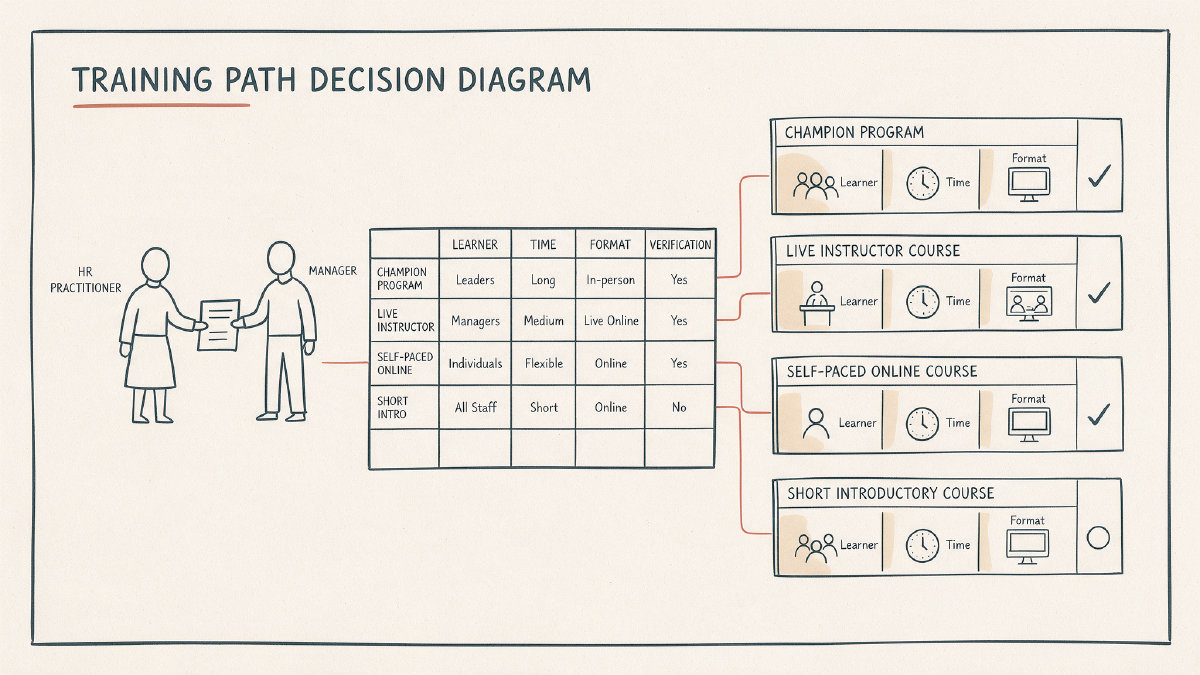
In order to help you make sense of the options out there, I’m going to lay out a simple decision framework. First, we’ll look at the four broad paths that companies take when they want to train employees on engagement topics:
-
Internal champions: Companies often start by building internal champions who can spread knowledge throughout the organization. These people might be HR professionals, or maybe managers themselves, or perhaps even individual contributors in the workforce.
-
Direct HR/leader learning: Some companies prefer to have direct learning experiences for their HR staff and leaders. This could involve courses designed for HR teams, or it could involve targeted sessions for managers.
-
Broad professional-development delivery: Some companies like to provide general corporate development opportunities to their employees. These might be training programs aimed at helping people become better at their jobs, regardless of whether those jobs are focused on engagement specifically.
-
Low-cost introduction: Many companies like to offer short introductory trainings to employees before investing in more comprehensive offerings. These might be free online videos, or brief courses that only cover basic concepts.
The main thing is that you need to figure out which of these four paths your company needs before you choose a specific provider. Once you know what type of program you need, you can then compare the options within that category.
Let’s look at each of these four categories.
Gallup
Gallup offers a range of products aimed at improving employee engagement. The most popular one is Gallup Creating an Engaging Workplace for Engagement Champions, a two-day course for internal champions. It’s offered as an in-person or virtual two-day, instructor-led course, and the Gallup Employee Engagement Hierarchy Quick Reference Card is listed separately among the materials you’ll receive.
LinkedIn Learning
LinkedIn Learning offers several courses related to employee engagement. The most popular one is LinkedIn Learning Employee Engagement, a 41-minute advanced course released on March 21, 2025. The course is taught by Don Phin and covers employee engagement fundamentals.
Dale Carnegie
Dale Carnegie offers a variety of products related to employee engagement. They offer In Person, Live Online, On Demand, and Online Subscriptions formats for their courses. Engagement-specific credits aren’t specified on the course-finder page, so you’ll need to confirm them for the specific course you choose.
Alison
Alison offers a free management course on employee engagement. This course covers topics such as talent management, retention strategies, employer brand, Maslow’s hierarchy, psychometric testing, and the Zinger Model of Employee Engagement.
Time and Delivery Burden
When looking at employee engagement trainings, it’s important to consider the time and delivery burden associated with each option. Here’s how to think about the time and delivery burden across live cohort, short online, video-based, and flexible organization-wide formats:
Live Cohort
Live cohorts require participants to attend sessions in real-time, either in-person or virtually. This format typically involves a significant time commitment, as sessions may last several hours or even days. Participants must be able to commit to attending sessions on specific dates and times.
Short Online
Short online trainings are usually shorter than live cohort trainings, but they still require participants to dedicate some time to complete the training. These trainings may be completed in a few hours or a few days, depending on the length of the training.
Video-Based
Video-based trainings can vary widely in length, from short lessons to courses that take several hours. Participants may need to watch multiple videos to complete the training, which could take up more time overall.
Flexible Organization-Wide
Flexible organization-wide trainings allow participants to complete the training on their own schedule. This format typically requires less time than other formats, but it may not be suitable for everyone.
Curriculum Topics
When choosing an employee engagement training, it’s important to consider the curriculum topics that are covered. Each provider has its own unique approach to teaching employee engagement, so it’s important to find a course that aligns with your company’s goals.
Here’s a look at the curriculum topics covered by each provider:
Gallup
Gallup’s curriculum includes topics such as engagement measurement, Q12 results review, action planning, coaching conversations, manager education, group practice, teach-backs, and facilitation tips.
LinkedIn Learning
LinkedIn Learning’s curriculum includes topics such as modeling engagement, hiring and onboarding, showing care, meaning, employee experience listening, flexible and remote work, inclusion, and technology.
Dale Carnegie
Dale Carnegie’s broader curriculum covers areas such as leadership, communication, presentation, sales, customer service, organizational development, and people skills.
Alison
Alison’s curriculum includes topics such as talent management, retention strategies, employer brand, Maslow’s hierarchy, psychometric testing, and the Zinger Model of Employee Engagement.
Credential and Learner-Material Differences
Each provider has its own credentialing process, so it’s important to understand what kind of credential you’ll receive upon completing the training. Some providers offer certifications, while others offer digital packets or downloadable materials.
Here’s a look at the credential and learner-material differences between each provider:
Gallup
Participants who complete the Gallup course can earn 14.5 professional credit hours from HRCI or 14.5 professional credit hours from SHRM. They also offer a range of learner materials, including a Digital Packet for the Engagement Champions Train-the-Trainer 2-day course, a Manager Packet for the Creating an Engaging Workplace course, a Quick Reference Card for the Gallup Employee Engagement Hierarchy, and Distribution Resources to Promote Engagement. They also offer a Learning Journal.
LinkedIn Learning
LinkedIn Learning offers a shareable certificate upon completion of the course. They also offer an exercise file, five quizzes, tablet and phone access, and course downloads.
Dale Carnegie
Dale Carnegie’s available credentials aren’t specified on the course-finder page, so you’ll need to confirm the certificate or credit details for the specific course you choose.
Alison
Alison offers a CPD-accredited Alison Certificate upon completion of the course.
Vendor-Reported Outcomes
There are a lot of vendor-reported outcomes for employee engagement trainings. But when interpreting these numbers, it’s important to remember that they’re just averages. A company may report that its engagement increased by 14 percentage points after taking a course, but that doesn’t mean that every company will see the same results.
Instead, it’s important to look at the number of companies that have taken the course. If a company reports that nearly 600 companies saw a 20 percentage-point increase in engagement, that’s much more convincing than if a company says that it saw a 14 percentage-point increase.
It’s also important to look at the estimated productivity return. If a company reports that it sees an $1,812 estimated first-year productivity return per employee, that’s much more convincing than if it says that it sees a 14 percentage-point increase.
Finally, it’s important to look at the number of employees that took the course. If a company reports that 2.5 million employees took the course, that’s much more convincing than if it says that it sees a 14 percentage-point increase.
Purchasing Checklist
When purchasing an employee engagement training, it’s important to keep a few things in mind. First, you should make sure that the training fits your company’s needs. Are you looking for internal champions? Do you want direct HR/leader learning? Or are you looking for a broader professional-development opportunity?
Next, you should consider the logistics of the training. Will you be able to attend the sessions in person or virtually? What are the dates and times of the sessions? How long will the training take?
You should also consider the syllabus depth. Does the training cover all of the topics that you’re interested in? Are there any prerequisites for the training?
Finally, you should consider the credentials that you’ll receive upon completing the training. Do you need a certification? Do you need a digital packet or downloadable materials?
By keeping these things in mind, you’ll be able to choose the right employee engagement training for your company.
Pricing Transparency
When looking at employee engagement trainings, it’s important to be transparent about pricing. Unfortunately, many providers don’t make their pricing information readily available. This makes it difficult to compare prices between providers.
However, there are a few ways to get pricing information. First, you can visit the provider’s website and look for pricing information. Second, you can contact the provider directly and ask about pricing. Third, you can look for reviews of the provider to see what other people have paid for the training.
Unfortunately, there isn’t a lot of transparency around pricing for employee engagement trainings. This means that it’s difficult to know exactly how much the training will cost before you purchase it.
Fit-Based Recommendation Pattern
After considering all of the factors above, it’s time to recommend a fit-based recommendation pattern. Here are a few options that I think would be a good fit for most companies:
Internal Engagement Champions
If you’re looking for internal champions, I’d recommend Gallup Creating an Engaging Workplace for Engagement Champions. This course is a great way to build internal capability around engagement.
Direct HR Professional or Leader Learning
If you’re looking for direct HR professional or leader learning, I’d recommend LinkedIn Learning Employee Engagement. This course is a great way to learn about employee engagement fundamentals.
Flexible Professional Development
If you’re looking for flexible professional development, I’d recommend Dale Carnegie. This company offers a variety of formats, so you can choose the one that best suits your needs.
Low-Cost Introductory Credential-Oriented Option
If you’re looking for a low-cost introductory credential-oriented option, I’d recommend Alison. This course is a great way to learn about employee engagement without spending too much money.
Current Provider Pages or Quotes
If you’re looking for a current provider pages or quotes, I’d recommend checking out the provider’s website. Most providers have a page dedicated to their employee engagement trainings, where you can learn more about the courses they offer.
Overall, I think that Gallup Creating an Engaging Workplace for Engagement Champions, LinkedIn Learning Employee Engagement, Dale Carnegie, and Alison are all great options for learning about employee engagement. Each of these providers has its own strengths and weaknesses, so it’s important to choose the one that best fits your company’s needs.