
There are many models of how you should go about running the recruiting and hiring process, including ones I've written about here at The New Stack. You can find those models in our Guide to Modern Talent Strategy or our guide on How to Create a Candidate Journey Map.
The most important thing is that the model you choose works for your team. But there are also best practices across the process as a whole that help ensure success, and these steps will help you get there.
The goal with this article is to walk through the full process — from planning through onboarding — and highlight how it’s not necessarily linear. That means transitions need owners, and there are multiple stages (we’ll use eight) that could be modified depending on your company.
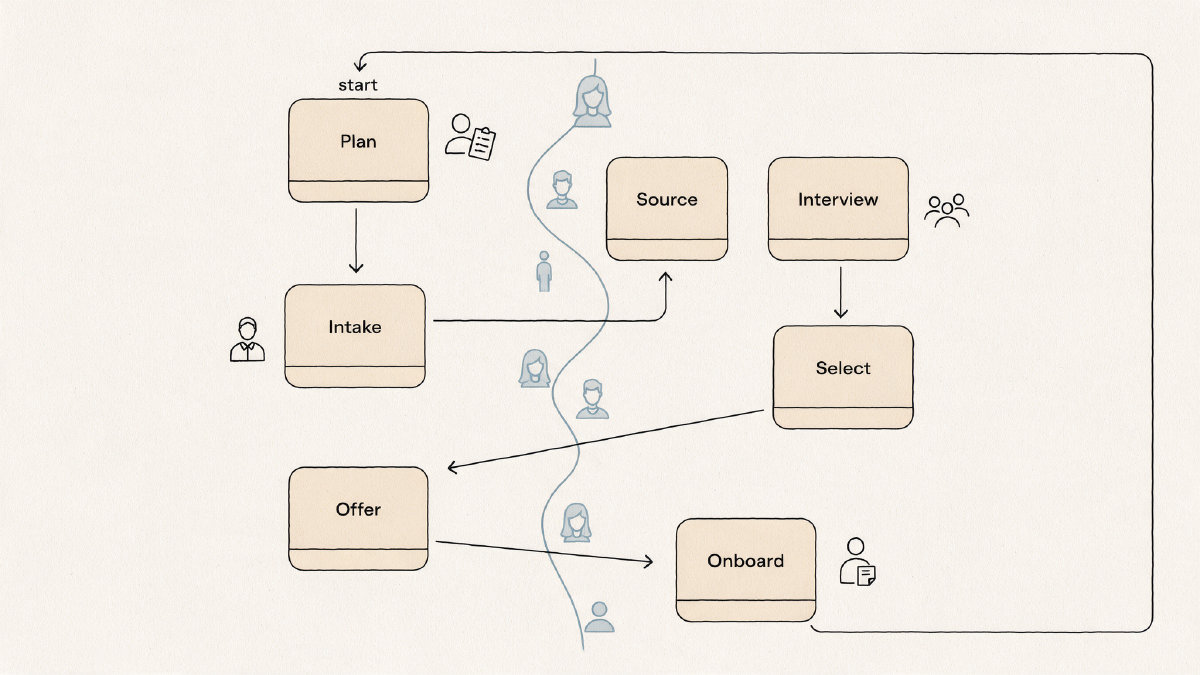
Recruiting and hiring isn’t just sourcing candidates and filling roles. It starts before the job posting goes live, with pre-posting workforce planning. It doesn’t stop when the hire completes training either; the new employee must learn what they need to know to succeed. All of that requires planning, execution, ownership, and tracking.
In general, we break the hiring process into 8 distinct stages: 1) workforce planning and role intake, 2) job analysis and interview playbooks, 3) sourcing, 4) screening, 5) interviewing, 6) selection, 7) offer and reference check, and 8) onboarding. Other sources might split these into five or six stages, while others might define more than 10. But each of these steps follows the same logic.
Workforce planning and role intake
Workforce planning ensures the right number of employees are hired and that the organization has the right people in place to meet its objectives. While some organizations may consider it a separate activity, for many teams it’s a core element of the hiring process.
During this time, HR, finance, the hiring manager, and recruiter collaborate to understand the business need and translate it into a specific role. There are several elements involved in defining the hiring plan:
HR leader and finance: Define the headcount and budget for the hiring plan.
Hiring manager and recruiter: Work together to understand what kind of role needs to be filled, the successful candidate profile, responsibilities, and qualifications, and create a practical timeline for the role.
Approved hiring plan: After all of the details are gathered, the hiring plan must be approved and budgeted. This is done after the role is defined.
Headcount and budget: Determine how many roles need to be filled, and the overall cost associated with doing so.
Role purpose: Define what the role does within the company, why it’s needed, and what skills and experience the person will need to perform it well.
Successful candidate profile: What type of candidate do you want? Who is this role ideally suited for?
Responsibilities: What will the role entail? Will there be any key tasks, projects, or outcomes tied to it?
Qualifications: Do they need a certain education? Years of experience? Specific certifications?
Timeline: When will the role be open? When is it expected to be filled?
Process owners: Who is responsible for each step of the process?
Salary range: What salary and benefits package will the company offer?
Approvals: Who approves the hiring plan? What are the necessary approvals required before the plan moves forward?
Job analysis and interview playbooks
When a hiring manager and recruiter have agreed on the role, they need to define exactly what the ideal candidate looks like. This includes writing a job description, outlining key competencies, creating an interview playbook, and identifying the number of interview rounds.
Job Description
Every company has its own format for a job description, and the language used can reflect the company culture. However, it should contain all the essential information, such as what the role entails, who the person will report to, where they’ll work, and what skills they should possess.
Competency-based interviews are becoming increasingly common in modern workplaces, as they allow companies to assess candidates based on what they’ve experienced. A good competency-based interview asks about situations, actions, and results, which helps identify whether someone is suitable for a role based on their past behavior.
Interview Playbooks
A hiring team may conduct different types of interviews for different positions, depending on the level of the role. These include resume reviews, phone screens, group interviews, and even panel interviews. Each interview round will be unique in how it’s conducted and what it’s trying to achieve.
Number of Interview Rounds
Depending on the size and complexity of the role, there may be one interview round with a single interviewer, multiple interviewers, or perhaps more than one round of interviews with a mix of internal and external stakeholders.
Interview Questions
You can write your own interview questions, purchase questions from third parties, or download them from a public repository. Either way, your interview questions should reflect what the ideal candidate will bring to the role and what skills and behaviors they’ll need to demonstrate.
Skills Mapping
Your role probably has a list of required skills, both hard skills (such as coding) and soft skills (communication). Your interview questions should align with that list.
Scorecard
Your interviews should be structured so that everyone evaluates candidates consistently. For example, you can use a simple scoring system to evaluate how well a candidate responds to an interview question, or use a detailed scorecard that considers everything from the candidate’s communication skills to their ability to think critically.
Rubric
A good interview scorecard includes specific criteria, such as what skills or behaviors you’re assessing. This allows every interviewer to apply the same standards during interviews, helping minimize unconscious bias.
Calibration
Some companies require their hiring managers to review their interviews once all candidates have been interviewed, comparing responses across interviews. This is especially useful for higher-level roles.
Sourcing candidates
Sourcing is an attraction stage that takes place before the actual interview. It’s often considered part of the entire hiring process, but really, sourcing refers specifically to attracting interest from potential candidates.
There are several ways to attract potential hires, including job boards, career sites, referrals, and direct outreach. There are also opportunities to use existing talent pools.
Using multiple channels helps increase the chances of connecting with potential candidates, as no single source offers a perfect match. Some candidates may prefer to search job boards, while others might enjoy the personalized touch of being referred directly to a hiring manager.
Recruiter or sourcer
A recruiter typically handles sourcing as part of a larger hiring strategy. A sourcer focuses solely on attracting candidates for a given role. Either way, they may use similar tools to attract candidates, though sourcers might work closely with hiring managers to determine the ideal candidates to pursue.
Job Boards
Job boards are online platforms that connect employers with potential job seekers. Examples include LinkedIn Jobs, Indeed, Glassdoor, Monster, and PayScale. Many recruiters post open roles on one or more job boards. Candidates will often visit these sites to look for roles that interest them.
Career Sites
More established companies often have their own careers sites, allowing them to present the company in its best light to potential candidates. In addition to job listings, a career site can provide information about the company culture, compensation, benefits, and other perks that make the company attractive to potential candidates.
Referrals
Referrals are another form of sourcing that can be very effective. They’re also relatively low cost. If you’re struggling to attract quality applicants, ask your current employees if they know of anyone they think would be a good fit for a role. Then follow up with a message inviting them to refer a friend.
Direct Outreach
Direct outreach involves reaching out to potential candidates personally. Whether through social media, email, or other channels, it’s usually an effort to engage the candidate directly. Some companies send out a short survey asking if the candidate is interested in a particular role, while others send a link to their careers page.
Talent Pools
Many companies maintain a list of passive job seekers whom they’ve connected with in the past. These are individuals who may not be actively searching for a new role, but could become a candidate if they see an opportunity they believe is appropriate for them.
Shortlist of Interested Candidates
While it’s true that sourcing is often seen as part of the entire hiring process, it’s really just a starting point. At this point, you’re looking for candidates who are interested in applying. From there, you move on to screen and assess the qualifications of those candidates.
Search and Email Sequences
If you haven’t yet created a candidate database, now is a good time to do so. As you interact with candidates, add them to the database. You can then send targeted messages to those candidates, offering them more information about the company or the role. Over time, this database will help you develop your ideal candidate profile.
Screening and interviewing
Screening and interviewing are two of the most important stages of the hiring process. But they serve different purposes. Screening serves to filter out unsuitable candidates, while interviewing serves to assess whether the candidate will be a good fit.
The difference between screening and interviewing is pretty straightforward: screening confirms that a candidate meets the basic requirements for a job, while interviews determine whether the candidate is the right fit for the position.
Resume Screen
First, we screen the candidate’s résumé to confirm that they have the skills and experience needed for the job. If they don’t, then we move on to the next candidate.
Basic Criteria
If the candidate meets the basic criteria outlined in the job description, then we move on to the next stage.
Phone Screen
Next, we conduct a quick phone screen to get a sense of what the candidate is like, both professionally and personally.
Role and Company Explanation
We explain what the role entails and the company’s expectations. We also describe the benefits that come with the role, including any bonuses or commissions that may be available.
Location or Work Arrangement
We also determine whether the candidate wants to work in-office, remotely, or hybridly.
Compensation Expectations
We also talk about compensation expectations, including what they expect to earn in their new role.
Onsite or Virtual Interviews
After that, we conduct a series of interviews with various people, both internally and externally, to evaluate the candidate further.
Several Interviewers
Finally, the hiring manager conducts a final interview with the candidate to make the decision on whether to hire them.
Deeper Questions
As we proceed, we begin to ask deeper questions about the candidate’s background, their professional goals, and their expectations for working with us. This is where we start to dig deeper into what they know about the company, the industry, and their future plans.
Assessments
In some cases, we may conduct additional assessments of the candidate, both formal and informal, to evaluate how well they communicate, how well they work under pressure, and how well they think critically.
Candidates who aren’t scheduled on time or who don’t receive updates are far less likely to accept a job offer than candidates who feel supported throughout the hiring process.
Recruiting coordinator
The recruiting coordinator is responsible for maintaining contact with all candidates throughout the hiring process. This includes scheduling meetings, providing updates, collecting feedback, and managing handoffs between different stages.
Mutually workable time
It’s always preferable to schedule interviews at a time that’s convenient for the candidate. That doesn’t mean they can always choose whatever time they want, but they should have a say in when they’re scheduled.
Relevant interview details
Recruiters can help streamline this by gathering and sharing relevant interview details with the interviewers, ensuring that they have all the information they need to prepare for the interview.
Prompt scheduling
Candidates who are told that an interview has been scheduled at 10 a.m. and then find themselves waiting for confirmation until the last minute are more likely to withdraw their application.
Candidate updates
Once the interview has taken place, the recruiting coordinator should provide the candidate with updates regarding the status of the hiring process. This helps maintain the candidate’s interest and increases the likelihood that they’ll accept an offer if they’re offered one.
Feedback deadline
Most employers require that all interviewers provide feedback within a certain period of time, usually a few days after the interview.
Phone-screen notes
Each interviewer should record their impressions of the interviewee, both positive and negative, as well as any comments that might help the team evaluate the candidate’s strengths and weaknesses.
Scorecards
Each interviewer should record the scorecard that they developed for the interview, making sure that they all score the candidate in a consistent way.
Named owner
At the end of the interview, the candidate should be handed off to the named owner of the hiring process. The recruiting coordinator should document this handoff, along with the deliverable that was provided to the hiring manager.
Structured evaluations are designed to minimize unconscious bias in the hiring process. Every interviewer evaluates candidates against the same set of competencies and records the evidence that supports each score.
Business objectives
Every business has its own set of business objectives that define what it wants to accomplish. Structured evaluation helps to ensure that the hiring process is aligned with those objectives.
Defined competencies
Each business defines its own set of competencies that define what qualities make a great candidate. Some organizations may use personality traits, such as conscientiousness, while others may focus more on specific skills, such as problem-solving and communication.
Consistent questions
To make the interview process fairer, every interviewer asks the same questions, allowing them to compare their responses objectively. In some cases, a hiring team might ask a question differently from one interview to the next, but they should still evaluate the candidate in the same way.
Deliberate process
A deliberate interview process includes careful preparation, thoughtful questioning, and a structured way to analyze responses. This makes the process easier for hiring managers, as they’ll already have the framework they need to evaluate a candidate objectively.
Rubric
A rubric is an excellent tool for minimizing bias in the hiring process. Using a standardized rubric, interviewers evaluate the same candidate against the same criteria. This provides an objective measure of how well the candidate meets the requirements for the role.
Candidate scorecards
In addition to using a standardized rubric, hiring managers may also use scorecards to evaluate the candidate against a standard set of criteria. Scorecards also help ensure that every candidate is evaluated fairly.
Anonymized assessments
Anonymizing the assessment makes it harder for hiring managers to evaluate a candidate based on personal biases or opinions. This also reduces the risk of favoritism.
Data and evidence
In addition to recording the scorecard, hiring managers should record the evidence behind their scores. By recording data that supports each score, they can show hiring managers exactly why they assigned a certain score.
Fair comparisons
Having a clear standard for evaluating candidates means that you can fairly compare all candidates based on their performance during interviews.
Calibration
Sometimes, hiring teams might disagree about a candidate’s abilities. Calibration is a process of reconciling these differences and ensuring that all members of the hiring team agree on the final score for each candidate.
Selection, references, and offer
After the hiring process has concluded, the next stage is the selection process. Here, the hiring team compares the finalists against the original criteria to select the best possible candidate. References are then completed through the organization’s internal process, and a clear offer is extended to the selected candidate.
Role roundup
All of the hiring team’s efforts culminate in selecting the final candidate, who has been identified as meeting the role’s requirements. This marks the conclusion of the initial phase of the hiring process.
Hiring team feedback
Once the hiring team has completed the interview and reference checks, they compile all of their findings and share them with the hiring manager. Based on this feedback, the hiring manager selects a candidate to offer the role to.
Finalists
Based on the hiring team’s findings, the hiring manager identifies the top contenders for the role.
Scorecard comparison
Based on the hiring team’s findings, the hiring manager evaluates all of the candidates against the original criteria. They then select the top contender for the role.
Stated criteria
Before making an offer, the hiring manager will evaluate the candidate against the original stated criteria. They will decide whether the candidate is the best fit for the role, based on their response to the interview questions and the strength of their references.
Reference checks
References are completed through the organization’s internal process. These are typically performed by HR or a third-party recruitment agency. Reference checks can be verbal or written, and can take a couple of days to complete.
Offer
After completing the reference checks, the hiring manager extends a clear offer to the top contender for the role. The offer includes details of the role, the responsibilities, and the compensation package.
Documentation and recordkeeping
Documenting the hiring process is important to avoid legal issues, and it’s crucial that the hiring team keeps track of all of the documents they generate during the process.
There are some common records that appear across most organizations, and then there are context-specific examples that depend on the company’s policy and legal context. Below are some examples of what’s typically documented:
Common records:
• Job descriptions
• Postings
• Applications
• Resumes
• Screening questions and results
• Interview questions and notes
• Tests and results
• Scoring matrices
• Reference records
• Correspondence
• Accommodation requests
• Final-hire records
Context-specific examples:
• OFCCP retention (One-year minimum)
• OFCCP retention (Two-year minimum)
• UW retention (Three-year minimum)
• Retention examples for small businesses (up to 150 employees)
• Retention examples for contracts with the federal government ($150,000)
• Retention examples for state/local governments (based on employment levels)
Of course, the hiring team must abide by its own company policy and legal requirements. The length of time a hiring team must retain these documents varies by jurisdiction, and some laws govern how long certain documents must be kept. For example, the University of Washington requires recruitment and selection records for staff to be retained for a minimum of three years after the recruitment concludes.
Interview notes are extremely important to the hiring process because they document how the hiring team thinks the candidate performs in terms of specific skills and behaviors. Disposition records explain the outcome of the hiring process, indicating whether a candidate was accepted, rejected, or is still being considered.
Activity dispositioning
The first thing that the hiring team should note about a candidate is the stage in the hiring process they were in at the time of the interview. Did they pass the screening stage and then move on to the next stage? Were they still being considered at the time of the interview?
Stage considered
If the candidate wasn’t yet in the interview stage, the hiring team can indicate the stage that they were considered for. This shows where the hiring process stood at the time of the interview.
Stage rejected
If the candidate was rejected for a specific reason, the hiring team can record that rejection as well. This is helpful in tracking where the hiring process stood at the time of the interview.
Rejected by whom
Who rejected the candidate? Did they reject them at the interview stage or during a later stage?
Reason
Why did the hiring team reject the candidate? Was it due to poor performance? A lack of experience? A conflict with company values? Whatever the reason, the hiring team should note it in the notes section.
Factual notes
Interview notes should include factual observations that the hiring team made about the candidate’s performance, rather than their opinion about how they should perform. For example, instead of saying “I think this person is lazy,” the hiring team should say “This candidate showed little initiative.”
Nondiscriminatory language
Interview notes shouldn’t be biased or discriminatory in nature. Avoid language that reflects a preference toward certain people or backgrounds, since that’s illegal and could result in the hiring team being fined.
Qualifications and skills
Instead, the interview notes should simply reflect what the candidate is actually able to do, based on their qualifications and skillset.
Consistent quality and quantity
The hiring team should also be consistent in the quantity and quality of notes they take during interviews. Otherwise, the hiring manager won’t be able to compare candidates to one another fairly.
Scores and interview results
Finally, the hiring team should summarize the scores and interview results for each candidate, to help them better understand how the candidate performed relative to the rest of the field.
Onboarding and integration
Onboarding is the process of transitioning a new employee into the organization and integrating them into the company. It’s the final stage of the recruiting process and the beginning of the employee’s journey within the organization.
After acceptance
Once the candidate accepts the offer, they begin the onboarding process. This includes signing the employment agreement and receiving all of the necessary materials.
HR
The HR department is responsible for setting up the new employee’s administrative files, enrolling them in benefits programs, and guiding them through the onboarding process. They may also coordinate the introduction of the employee to other employees.
Hiring manager
The hiring manager is responsible for orienting the employee to their new role and teaching them the fundamentals of their new job. The hiring manager may also assign mentors and trainees to the new employee.
Week 1 – Administrative setup
Week 1 consists of the administrative setup of the employee’s workstation. This includes setting up the computer, installing the software that the employee will use, and assigning a mentor to the new employee.
Team introductions
During week 1, the employee will also be introduced to the team. During the first week, the employee will learn what their responsibilities are and what their day-to-day expectations are. Employees are also asked to set their 30/60/90-day plan during this time.
Weeks 2-4 – Training
During weeks 2-4, the new employee will be trained on how to perform their daily tasks. The new employee may shadow senior employees to learn how to perform their tasks effectively.
Weeks 2-4 – First deliverables
The new employee is expected to perform the first deliverables during weeks 2-4. If they’re unable to complete the task, the hiring manager will help them to do so. Regular check-ins are held to determine whether the employee is performing up to expectations.
Months 2-3 – Increasing responsibility
During months 2-3, the employee is expected to take on increasing responsibilities and perform more complex tasks. This is when employees are asked to provide feedback to their supervisor and co-workers.
Months 2-3 – Feedback loops
Feedback loops are a critical part of the onboarding process. Employees are encouraged to provide feedback to their supervisors and co-workers, both positive and negative. They’re also asked to provide feedback about their new role and the company itself.
Month 4+ – Integration
By month four, the goal is for the employee to be integrated into the company. He or she should be comfortable performing the role independently and be contributing meaningfully to the company’s goals.