
I don’t know how long the recruiting process will take for you. But I can tell you what mine looks like, and how it compares to other employers’ timelines.
Total time-to-hire typically ranges from 21–28 days for aggressive, entry-level, or high-urgency hiring; 30–40 days for most professional roles; or 45–60 days for senior or specialized roles. These are all very rough estimates, but they’re in line with some cross-industry averages (which vary wildly depending on whether you count days or weeks). For example, a survey of U.S. companies found that the average time-to-hire was 44 days, while another survey of 750+ employers found that about 71% of hires were made within 3–6 weeks after the first interview, and 19% took seven weeks or longer.
Standard Recruiting Timeline
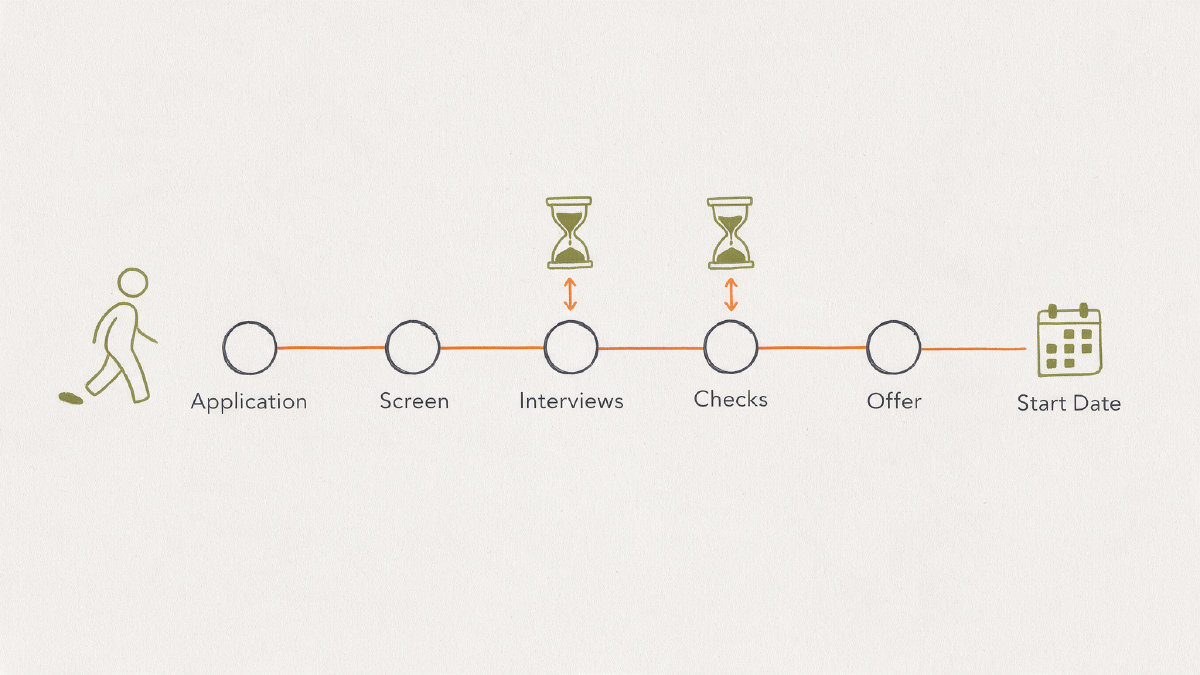
But these are just averages. In reality, the length of the recruiting process depends on how many steps you have to go through, how long each step takes, and how well things run smoothly. If you want to estimate how long your particular hiring process will take, here’s a standard timeline:
Application review/response: 2–3 days
Phone screen: 5–7 days
Interview rounds: 10–14 days
Reference/background checks: 5–7 days
Offer preparation: 4–5 days
In most cases, interviews and reference checks are the stages that consume the most calendar time, since they often involve waiting for people who aren’t working for you to get back to you. This can be especially true if your interviews require multiple stakeholders or if you’re interviewing senior/specialized candidates. The more interview rounds you have, the longer the verification process will take as well. Reference checks usually only take a few days, but background checks can sometimes stretch into a couple of weeks. Here’s how long each stage normally takes:
Interview rounds: 7–14 days
Senior/specialized interviews: 14–21 days
Each added round: 3–5+ days
Reference checks: 3–5 days
Background checks: 3 days–2 weeks
Timeline by Role and Industry
Of course, this timeline varies depending on your role level and industry group. Frontline/high-volume roles tend to move much faster than moderate- or longer-roles, and non-specialized healthcare tends to move faster than technology/media or investment banking. Here’s how hiring pace breaks down by role level and broad industry group:
Frontline/high-volume: 14–25 days
Retail and consumer services
Hospitality and food service
Cleaning services
Transportation
Moderate roles: 30–40 days
Technology and media
Sales and marketing
Administrative roles
Non-specialized healthcare
Longer roles: 45–70+ days
Energy and defense
Professional services
Investment banking: 21–60+ days
Executive searches: 90–120+ days
These differences reflect specialization and evaluation complexity rather than any universal rule. The more specialized a role is, the more time an employer has to spend evaluating a given candidate, which naturally stretches out the hiring process. Similarly, the more complex the evaluation process is, the more time it takes to make a decision.
Common Recruiting Delays
Of course, the actual timeline also depends on internal bottlenecks. Too many interview rounds, limited stakeholder availability, unclear round purpose, no structured decision process, individual instead of batch scheduling, high application volume, waiting for more candidates, analysis paralysis, late reference requests, unresponsive references, extensive verification scope, and complex offer negotiations can all stretch out the recruiting process beyond the planned stage estimates.
If you’ve had an interview and haven’t heard anything back yet, it doesn’t necessarily mean you were rejected. It might just mean that the company is taking its time. Hiring managers often give feedback after interviews, but it can take additional stakeholders to finalize a decision. Candidates may also be compared against one another during this period, and the company may be waiting to check references or conduct background checks before making a decision. A lack of communication doesn’t always mean rejection; it might simply mean that the company is still trying to decide who to hire.
Interview Follow-Up Timing
If you want to follow up with an employer after an interview, here’s a good timing guide. Most candidates expect to hear back within 24 hours of an interview. About 66.1% of job seekers expect a response within 24 hours of an interview, while 38.7% say that slow communication reduces their brand interest. You should definitely follow up after the stated deadline, and if there isn’t a deadline, wait about one week after your interview before following up.
Even if you accept an offer, there’s usually a transition period before Day 1. Standard notice periods range from two to four weeks, and executive transitions may take even longer. Acceptance of an offer doesn’t necessarily mean that you’ll start on the date you wanted. There’s still work to do before Day 1.
You should keep interviewing until the outcome is concrete. Offer uncertainty is a big part of the hiring process, and competing-offer behavior means that a promising update doesn’t necessarily mean that you’ve secured the role. About 73% of offers are accepted, though about one in four offers are declined. In the recruiter survey, accepting another job offer was cited as the reason 44% of turned-down offers were declined. So even if you get an offer, you shouldn’t stop looking for alternatives. Once you get a clear written offer and confirmed next steps, however, it’s probably best to stop looking.
Recruiting Benchmarks for Employers
Employers can use time-to-fill and time-to-hire benchmarks diagnostically. Time-to-fill begins at requisition opening/approval, whereas time-to-hire begins at application or sourcing. Approval delays, job posting and sourcing delays, screening, interviews, decision, and offer are all different parts of the hiring funnel. Benchmarks are directional references, not requirements.