Employee engagement activities and ideas are like a targeted operating library of activities to choose from, not a list of perky perks.
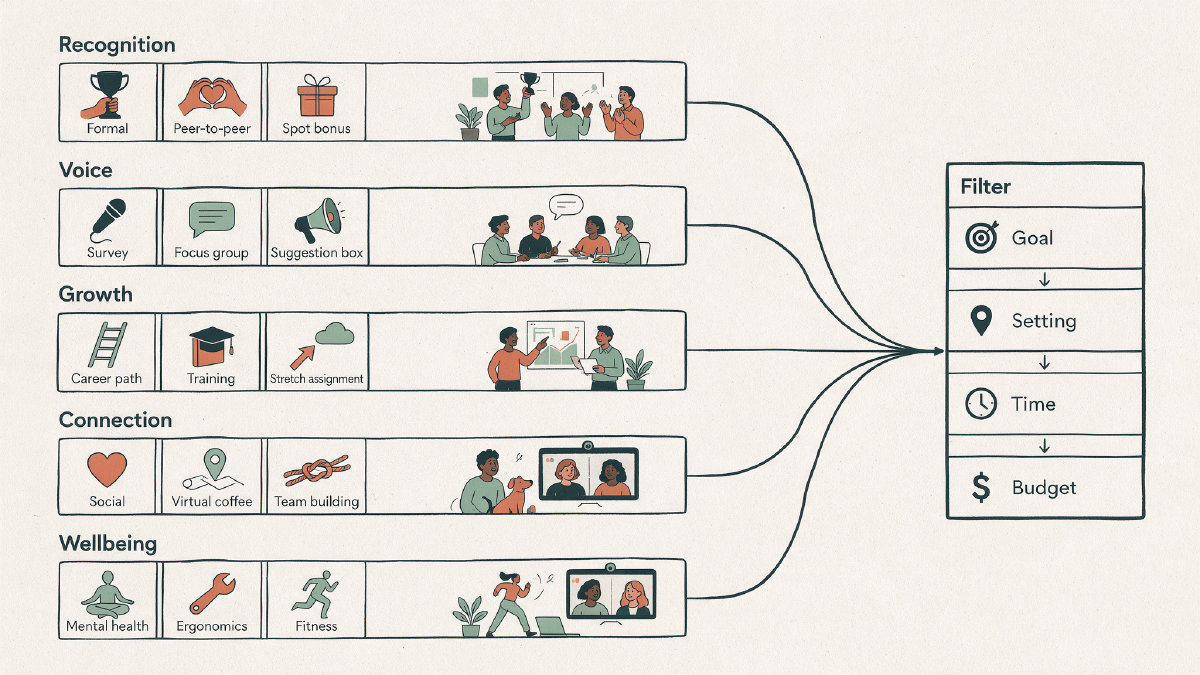
Choose one or two things around a specific goal. Be sure to consider real constraints before scaling up, such as:
Recognition
Belonging
Voice
Growth
Wellbeing
Budget
Time
Work setting
Team capacity
30 to 60 days
Participation and sentiment
The more you can define these, the easier it’ll be to narrow your focus. Then try out one activity first; wait, collect data, and adjust before scaling.
If this sounds too simplistic, it is — but it also works well. Why? Because employee engagement is about choices, and employees are people who make choices.
Let’s get started!
1. Recognition Activities
A good recognition activity makes appreciation specific, and recurring. Peer-based voluntary acknowledgment has value, but so does being acknowledged by managers. Both should be linked to specific actions that show their value. But generic praise or competitive awards have limited utility.
Gratitude wall: A physical or digital place where employees can write down what they appreciate about each other. It could be as simple as a whiteboard where people add sticky notes (Post-it) notes of gratitude. Or an app that allows for “shoutouts” on specific skills. Alternatively, you could ask people to send a message of gratitude to a co-worker via email or LinkedIn.
Peer recognition: People often feel most valued when peers acknowledge them. This could be done with a formal program, but it’s worth noting that some peer-acknowledgment programs allow for anonymous recognition of coworkers.
Quiet-contributor awards: If you’re trying to build culture, quiet contributors may not receive attention in a public award system. Try recognizing the small, quiet contributions of those employees instead.
Spot awards: These can be given in recognition of particular milestones or achievements.
Real-time recognition: In today’s work environment, we often don’t know if we’ve been appreciated unless someone tells us. When possible, pair a real-time recognition effort (like giving thanks at a meeting) with a follow-up that connects with a manager or peer.
Low cost: Some recognition efforts have low overhead and could be repeated multiple times. For example, a gratitude wall doesn’t require any upfront investment and can be scaled easily. However, some recognition efforts will require time and planning.
2. Voice and Transparency Activities
When we talk about voice, it refers to employees feeling able to speak freely, whether formally (e.g., through suggestion boxes) or informally (through spontaneous conversation). Voice isn’t simply a question about “what do you think?” but about making it clear to all stakeholders that listening matters and how listening will translate into meaningful change. That means pairing informal listening opportunities (i.e., listening to what employees say and then doing something about it) with public themes, answers, and a small set of visible commitments.
Pulse surveys: Many companies use pulse surveys to check in on employees’ moods. The results can be shared quickly and anonymously. Pulse survey responses can reveal trends over time that might help shape company decisions.
Quick results sharing: Sharing results quickly helps employees understand how their feedback is used. While many organizations share survey findings internally, they may take weeks to process. Quick feedback gives employees confidence that their voices are heard and taken seriously.
Visible achievable changes: When an organization commits to specific changes as a result of feedback, that commitment is very important. You need to make those commitments known.
Emoji reactions: One way to keep pulse surveys light and engaging is to use emoji as a response option. An emoji can express positive, negative, or neutral emotions quickly without lengthy explanations.
Optional anonymous comments: Some pulse survey platforms offer the ability to provide additional feedback after submitting the survey. Anonymous comments are helpful, especially if you suspect certain employees are reluctant to speak up directly.
Suggestion box: Whether it’s online or paper, suggestion boxes are a traditional form of feedback. You can pair them with quick results sharing to demonstrate that you listened.
Leadership office hours: Leaders can offer scheduled open hours during which employees can come and ask questions or voice concerns.
Drop-ins: Similar to open hours, drop-in meetings allow employees to connect informally.
AMA (Ask Me Anything): Hosted by leaders, AMAs give employees an opportunity to ask questions and raise concerns about any issue affecting the organization.
Public follow-up: Follow up publicly on AMA topics. If there’s a lot to discuss, you can follow up later with a team of managers.
Reverse town halls: Reverse town halls are meetings where employees can pose questions to leaders.
Stay interviews: Conduct stay interviews to discover what keeps employees motivated and what might cause them to leave the company.
3. Lightweight Career Growth & Learning Practices
You shouldn’t have to rely solely on large, expensive learning-and-development programs to create career growth and learning access. Employees benefit from progression being visible. At the same time, development doesn’t have to require long periods of time, travel, or a large investment in time or money. Consider lightweight practices to support employee learning.
Career maps: Create a visual representation of careers and progression paths within your company. Include skills, experiences, and milestones associated with different positions. A career map should include everything an employee needs to move forward and develop professionally.
Development 1:1s: Hold regular one-on-one conversations between employees and managers. Development 1:1s help ensure employees aren’t left behind and aren’t left waiting for guidance.
Mentorship: Pair junior employees with senior mentors. Senior mentors help juniors gain knowledge about roles and how to succeed within the company.
Coaching: Coaching provides employees with personal and professional growth opportunities. Coaches typically work closely with individual employees.
Micro-mentoring: Micro-mentoring sessions can be opt-in, 20-minute conversations between people at different levels. They can occur at lunchtime, during meetings, or in other short blocks of time.
Lunch and learns: Lunch and learn events involve brief presentations about various subjects followed by Q&A sessions. These events promote continuous learning.
Workshops: Workshops provide in-depth learning about a topic. They may last longer than lunch and learns but aren’t necessarily part of a larger educational curriculum.
Shadowing: Shadowing allows new hires to observe experienced employees performing their jobs. Shadowing is useful for training, onboarding, or gaining insight into day-to-day operations.
Role rotation: Role rotation is a method of providing cross-training. Employees rotate between departments to learn the business from the inside out.
4. Connection Activities
It’s difficult to build strong connections when teams are separated by geography or when teams lack visibility into each other’s work. To build connection, you can try these activities across in-office, remote, hybrid, and frontline contexts:
Casual team meals: Team meals can foster casual interactions and bonding. Meals are best done regularly rather than once every few months.
Virtual coffee breaks: Virtual coffee breaks are similar to in-person coffee breaks. Schedule them regularly so employees can look forward to them.
Book club: Reading is an excellent way to bond with colleagues and broaden perspectives. Book clubs encourage reading and conversation, allowing employees to share opinions and thoughts.
Leadership books: Encourage employees to read leadership books to improve soft skills. Leadership books can be paired with book clubs.
Industry trend books: Stay ahead of industry trends by having employees read about the latest developments in the field. Industry trend books are particularly beneficial for newer employees who might otherwise miss out.
Fiction: Fiction is another great book club option. It promotes creativity and offers fresh perspectives.
Internal networking events: Networking is vital for career growth. Internal networking events help employees build relationships.
Cross-team introductions: Introduce employees to members of other teams. Cross-team introductions can be fun and enlightening.
Internal newsletter: Create an internal newsletter to communicate updates and news to employees. Newsletters are particularly beneficial for remote workers.
Company updates: Keep employees informed of what’s happening in the company. Company updates can be included in newsletters.
Employee stories: Share employee stories in the newsletter to humanize the company.
Team wins: Celebrate team wins to highlight successes and encourage teamwork.
Peer recognition: Recognize employees for their work.
Small-group events: Small-group events are great ways to foster camaraderie. Think about group lunches or happy hours.
5. Embedding Engagement Into Existing Workflows
Embedding free or inexpensive engagement practices into existing workflows avoids the pitfalls of adding another event to the calendar, and eliminates the expense of relying on costly, one-off solutions.
Gratitude posts: Send employees a quick note of appreciation for their hard work. Gratitude posts don’t cost anything and can be repeated frequently.
Coffee chats: Use coffee chats as a quick way to meet employees. Coffee chats can be scheduled with a coworker for a cup of coffee.
Peer learning: Help employees grow and develop by allowing them to learn from others. Peer learning involves sharing knowledge with colleagues.
Feedback reactions: Provide reactions to employee feedback to let employees know that their opinion is valuable.
Flexible-work experiments: Test flexible work arrangements to see if they increase engagement and productivity. Flexible-work experiments can be implemented with minimal investment.
Meeting reductions: Reduce the number of meetings employees must attend. Meeting reductions save time and energy.
Newsletter shoutouts: Feature employees in the company newsletter. Newsletter shoutouts can be combined with gratitude posts.
Short development conversations: Hold brief development conversations between employees and managers. Short development conversations don’t take much time.
Quarterly meeting bonfire: Host quarterly meeting bonfires to celebrate success. Quarterly meeting bonfires are inexpensive to implement.
Automatic recurring-meeting cancellation: Cancel recurring meetings that aren’t essential. Automatic recurring-meeting cancellations save time.
Re-pitch why the meeting matters: Re-pitch meetings that are essential. Re-pitching ensures that the meeting is worthwhile and that the right people attend.
6. Wellbeing, Autonomy, and Workload Activities
Employees respond better to workplace environments that reduce pressure. That means reducing workload and offering greater autonomy wherever possible. However, not all wellbeing activities are equally impactful, and not all will appeal to all employees. Where possible, allow optional participation and offer a choice in how wellbeing activities take place.
Choose Your Own Workday: Allow employees to decide how they want to spend their workdays. Choose Your Own Workday gives employees autonomy.
Flexible hours: Offer employees flexible working hours. Flexible hours can help accommodate childcare needs, health challenges, and other life responsibilities.
Meeting-free blocks: Set aside time that doesn’t involve meetings. Meeting-free blocks allow employees to work on independent tasks.
Solo work choices: Let employees decide whether to work independently or collaborate with others. Solo work choices allow for flexibility.
Collaborative work choices: Collaborative work choices are just the opposite of solo work choices. Collaborative work choices enable teams to work together on tasks.
Meeting cancellations: Cancel unnecessary meetings. Meeting cancellations can save time and energy.
Mindfulness sessions: Mindfulness sessions teach mindfulness techniques. Mindfulness sessions are particularly beneficial for newer employees who might otherwise miss out.
10-minute guided practice: Guided mindfulness sessions take only 10 minutes to complete. Employees can complete them anywhere, anytime.
Stretching breaks: Stretching breaks help relieve stress and prevent fatigue. Employees should complete stretching breaks regularly.
Optional wellness challenges: Optional wellness challenges help keep employees active and healthy. Wellness challenges should be optional and based on employee preferences.
No competition: Avoid wellness challenges that turn wellness into a performance demand. No competition helps employees remain healthy without adding extra pressure.
Employee preferences: Let employees decide whether to participate in wellness activities. Employee preferences help determine what wellness activities are successful.
7. Onboarding Activities for New Hires
New hires may take a little bit of time to adjust to a company’s culture. As a result, it’s a good idea to introduce new hires to your culture during their first 30 to 90 days on the job. Here are a few onboarding activities to consider during that time:
Structured onboarding: Make sure that your onboarding plan is structured properly. This will ensure that your new hires understand the expectations and what to expect as a new hire.
Clear onboarding plan: Develop a clear plan for onboarding that outlines what employees will do and when. Clear onboarding plans reduce confusion.
Early check-ins: Schedule early check-ins with new hires. Early check-ins help ensure that new hires are comfortable and satisfied with the role they’ve accepted.
Clear expectations: Make sure that your new hires understand what is expected of them. Clear expectations help new hires succeed in their roles.
Introductions: Introduce new hires to other employees who will work with them. Introductions are particularly helpful for remote and hybrid teams.
Resources: Provide new hires with the resources they need to succeed. Resources can include documentation, software tools, and other information.
Onboarding buddies: Pair new hires with an onboarding buddy who can answer questions. Onboarding buddies help new hires feel welcome.
30 to 90 days: Don’t forget to check in on your new hires during their first month. Check in again at the end of 30 days.
Remote onboarding: Consider offering remote onboarding for new hires who may not live near your office. Remote onboarding is particularly helpful for global companies.
Hybrid onboarding: Hybrid onboarding combines both in-office and remote onboarding methods. Hybrid onboarding is helpful for companies with multiple offices.
8. Inclusion for Frontline and Hybrid Employees
Frontline employees and employees who work remotely or hybridly often experience unequal treatment because they’re physically separated from management and decision-makers. Location, shift patterns, and access to information can create unequal experiences, but there are ways to ensure frontline and hybrid employees receive equal treatment.
Frontline teams: Frontline employees usually refer to employees who work in customer-facing roles. Ensure that frontline teams are recognized as a unique group.
Remote-friendly equivalents: Ensure that remote-friendly equivalents exist for in-office benefits, such as a stipend to buy groceries instead of food vouchers. Remote-friendly equivalents help ensure that employees who work remotely are treated fairly.
Coffee vouchers: Coffee vouchers provide employees with a way to purchase coffee. Coffee vouchers help treat employees equitably.
Fitness stipends: Fitness stipends help employees afford gym memberships. Fitness stipends help treat employees equitably.
Location-based perks: Offer location-based perks to employees who work in different areas. Location-based perks help treat employees equitably.
Free snacks: Free snacks provide employees with a way to satisfy hunger. Free snacks help treat employees equitably.
Two-tier culture: Two-tier cultures exist when two tiers of employees are treated differently. Two-tier cultures exist in many organizations.
Accessible scheduling: Offer employees the opportunity to schedule meetings using an accessible calendar. Accessible scheduling helps ensure that all employees can schedule meetings effectively.
Shared newsletter updates: Update all employees, regardless of where they work, with company updates via shared newsletters. Shared newsletter updates help ensure that all employees are aware of what’s going on in the company.
9. Measuring Engagement Activities
You should measure how well engagement activities work, but avoid measuring them too strictly. Instead, track a few basic leading signals:
Attendance
Repeat participation
Survey completion
Comments
Manager involvement
Then, conduct some short pulse feedback to get input on how well these activities were received. There are a few layers to tracking engagement:
Participation layer
Communication engagement layer
Sentiment layer
Retention should be viewed as a directional indicator rather than as proof that a single activity caused the desired outcome. Similarly, performance should also be viewed as a directional indicator.
Avoid attributing outcomes exclusively to a single activity. Instead, recognize that retention and performance are directional indicators that may suggest an engagement activity worked, but it may not be the sole reason.
There are four simple steps to implementing these strategies:
Don’t try to run every idea at once. Run a few ideas at a time.
Run consistently. Don’t abandon an idea if it’s not immediately effective.
Track how employees engage and what sentiments employees convey.
Measure the impact of your ideas. Measure whether they’re increasing employee engagement and improving retention.
There are some guardrails to consider when implementing these engagement strategies. First, consider what engagement looks like for employees. Is the approach fun and optional? Are there ways for employees to opt out of activities? Do employees know how to access these activities?
Next, consider what the approach implies for managers. Are they asked to act in new ways? How many activities would they need to support? Is there room for managers to say no?
Finally, consider what your approach communicates. Does it imply that your company is fun? Does it imply that managers should care about feedback?
To summarize, consider the following when rolling out your new engagement ideas:
Offer optional participation
Create small social moments
Maintain a regular cadence
Demonstrate visible follow-through
Scope activities appropriately
Make events inclusive
Respect the capacity of managers
Rotate your focus over time
Try only a small number of ideas at a time
Run your ideas consistently