
This is the first in a series of posts about employee engagement. It’s not intended as a comprehensive guide, but rather as a quick-start template for building your own questionnaire. I’ll explain how to structure it and what to ask — and why you shouldn’t copy Gallup’s Q12.
I’ve written before about how employee engagement is often misunderstood. Engagement is not a measure of contentment with job conditions like pay or benefits. Instead, engagement measures how people think, feel, and act toward organizational goals. This includes their motivation, commitment, discretionary effort, emotional connection, and recommendation of the company as a place to work.
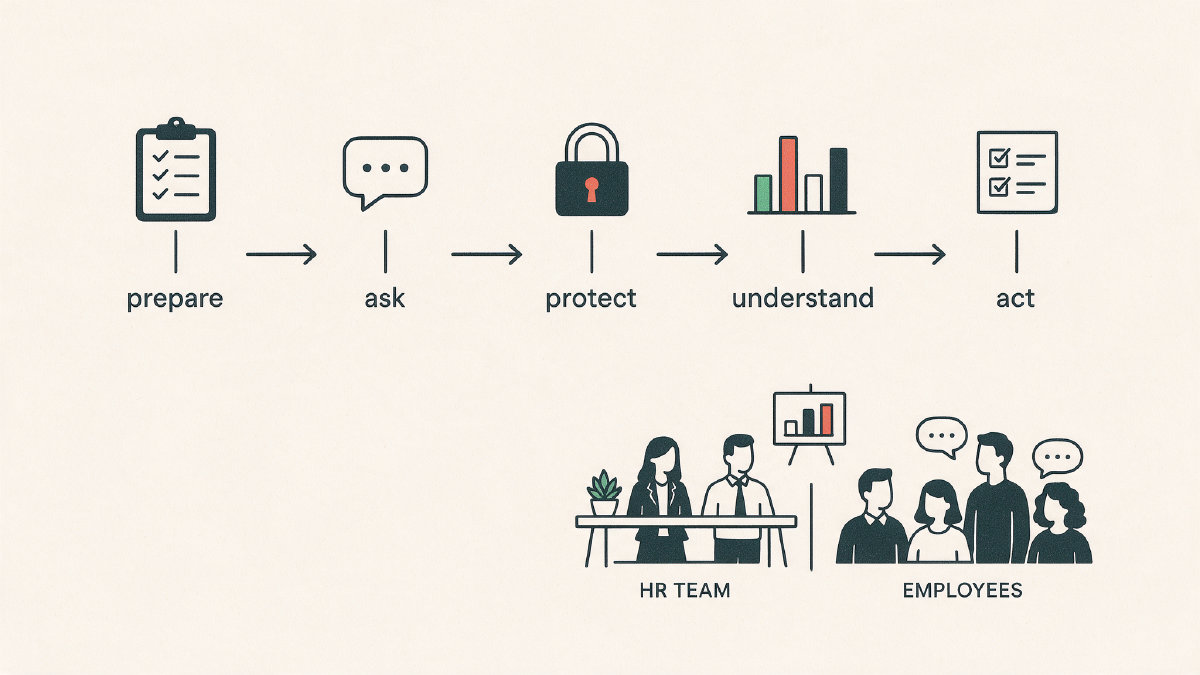
In this post, I’ll walk through how to build an employee engagement questionnaire. I’ll start by defining the basic architecture of such a survey. Then I’ll describe some practical tips for wording questions and designing the response scale. Finally, I’ll talk about how to interpret results once they come back.
Questionnaire architecture
Let’s start with the basics. An employee engagement questionnaire should measure outcomes that reflect how engaged employees are, while also measuring the conditions that drive those outcomes. There are three kinds of outcomes:
Think: How motivated or committed employees are
Feel: How emotionally connected employees are
Act: How much discretionary effort employees put into their jobs
These outcomes can be broken down further. For example, “how motivated employees are” might include things like whether they have what they need to do their work, understand expectations, feel heard, receive recognition, etc.
The most important thing is to make sure that the questionnaire measures the outcomes you care about. That means asking questions that get at whether employees are thinking, feeling, and acting in ways that support organizational goals.
You should distinguish between outcomes and the conditions that drive them. For example, if you want to know whether employees recommend your company as a great place to work, you should measure their recommendation directly. Don’t try to infer their recommendation from other factors like pay or benefits.
Questionnaire structure and themes
Here’s one way to structure your questionnaire. First, you’ll want to measure a compact index of engagement outcomes. Then, you’ll want to measure selected core drivers of engagement. Finally, you’ll want to add organization-specific items that your company can act on.
Core engagement index (e.g., pride, recommendation, present commitment, future commitment)
Motivation, intent to stay, work involvement
Leadership, enablement, alignment, development, recognition, communication, resources, manager support, growth, culture
Optional organization-specific topics
You can adapt these themes into statements, depending on your HR department’s preferences. But please note that the exact wording of the Gallup Q12 is proprietary, so you shouldn’t reproduce it verbatim as a copy-ready template.
Proud to work here
Recommend as a place to work
Intend to stay
Motivated to contribute
Have what I need to do my work
Understand expectations
Feel heard
Receive recognition
Opportunities to learn and grow
Gallup Q12
Proprietary
Response scales and question format
Use a consistent 5-point agreement scale as the default. If you want to use any 5-point quality or rating questions, make sure to clearly label them as such.
Use that one order throughout the survey — either Strongly agree to Strongly disagree, or the reverse — rather than mixing agreement, Very good to Very poor, and other rating formats without clear labels.
You can optionally add a small set of open-ended questions to explain ratings and surface missing themes. These free-text questions don’t turn the questionnaire into an essay assignment, because they’re optional and the quantitative scores will help you identify where the gaps are.
What is working?
What should change?
Anything the survey did not ask?
Quantitative scores
Missing themes
Length and survey cadence
There’s no universal benchmark for length. Some surveys have 30–50 questions, others have 57. Some take 10 minutes, others less than 5. The goal is to find the shortest questionnaire that supports the actions you want to take based on the results.
A full survey can run annually or biannually, with quarterly pulses between rounds. If you’re starting fresh, use the first survey as the benchmark; after that, checking in every six months is a practical default. Whatever cadence you choose, consistency and follow-through matter more than asking constantly.
Anonymity and confidentiality
When collecting data, you need to protect respondents’ identities. You should distinguish between anonymity and confidentiality. In practice, that means enabling anonymous responses before distributing the survey, and suppressing small reporting slices.
Anonymity
Confidentiality
Enable anonymous responses before distribution
Names
Email addresses
Identifying demographic details
5–10 responses per slice
Small-segment suppression
Practical safeguard
Scoring and interpretation
You can score the questionnaire using a straightforward method. Convert each 1–5 answer into a theme average. Combine those averages into an overall engagement index. Interpret results through internal trends, theme contrasts, and qualitative context, rather than through universal score bands.
1–5 scores
Theme averages
Overall engagement index
1.0–5.0
Internal trends
Theme differences
Qualitative context
Template-specific interpretation bands
Benchmark percentages
Twice a year
Vendor- and methodology-specific benchmarks
Sharing results and taking action
Once you collect the data, share the results broadly. Choose a few priority areas, assign action plans, involve leaders and managers, communicate actions visibly, and follow up with a short pulse to check progress.
Share high-level results, pick a small number of priority areas, and turn each into clear action plans owned by leaders and managers. Visible follow-through protects future participation: when employees see a follow-up pulse lead to real change, the survey becomes worth completing again.