
Employee onboarding is the process of integrating a new employee into their role and the organization.
The word “onboarding” has become so common in HR that it’s easy to forget what it actually means. This article will explain the meaning of onboarding, with some practical examples.
Employee onboarding is the process of integrating a new employee into their role and the organization. It encompasses both the structural aspects of the job (what they’re supposed to do) and the cultural aspects of the organization (how things are done). In short, it’s about helping someone move from being an outsider to being a functioning member of the team.
In other words, employee onboarding is about helping people become effective at their jobs. It’s not just about welcoming them or doing paperwork — it’s about making sure that they understand the structure of the organization, the culture of the organization, the mission of the organization, the values of the organization, the expectations of the organization, and how they can be effective at their roles.
It’s also important to note that the term “onboarding” is sometimes used more narrowly. For example, when you hear the phrase “employee onboarding,” it may refer to the specific set of activities that happen right after someone accepts a job offer. But I think this usage is incorrect. Onboarding should refer to the entire process of integrating someone into the organization, which begins before they even start working for you.
Onboarding and the employee lifecycle
The employee lifecycle includes several stages:
Before day one
Accepted job offer
First day
30 to 90 days
Six months
Full year
Up to 12 months
And so on
These stages aren’t necessarily fixed; some organizations will begin onboarding earlier than others, depending on how much preparation they want to do before the first day. But regardless of when onboarding starts, it continues until the person is able to perform their role independently.
Some sources say that the onboarding process lasts anywhere from one or two days up to 12 months. I’m not sure if this is accurate. If anything, I’d guess that the average onboarding period is around six months.
Onboarding versus orientation and training
But there’s another way to look at it. Orientation is the narrow part of the onboarding process that happens right after the first day. Orientation consists of handing out forms, explaining routine tasks, going over policies, introducing everyone to each other, and handling administrative procedures. That’s all part of onboarding, but it’s not the whole thing.
So while orientation is part of onboarding, it doesn’t cover everything that onboarding entails. Training is also a part of onboarding, though it usually refers specifically to knowledge or skill-building activities. Other parts of onboarding include cultural integration, relational integration, operational integration, and role integration.
Pre-boarding in onboarding
There’s also pre-boarding, which is the early phase of the onboarding process between when someone accepts a job offer and when they officially start working for you. Pre-boarding includes activities like sending informational material, preparing equipment and access, setting first-day expectations, inviting the new hire to tour the facility, and giving a care package. But pre-boarding shouldn’t become the whole onboarding process.
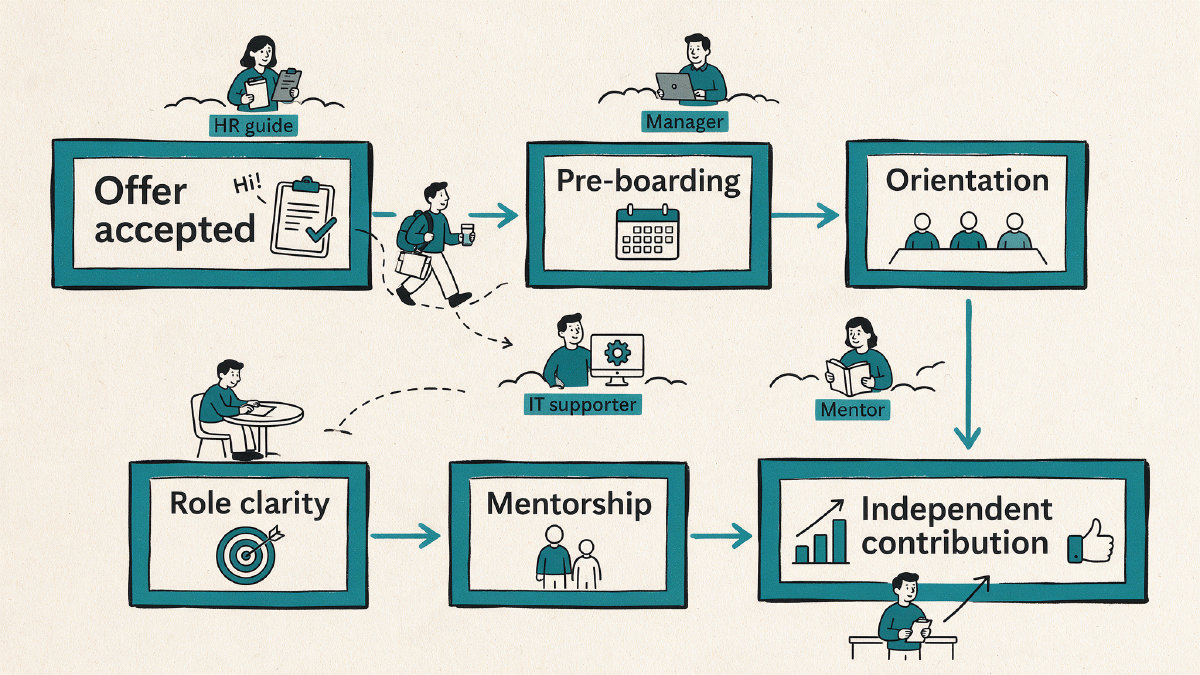
A typical onboarding process might consist of these components:
Preboarding
Orientation
Foundation building
Manager guidance
Mentoring or buddy support
Increasing role ownership
Each of these steps contributes to the overall goal of integrating the employee into the organization. Preboarding involves getting ready for the new hire’s arrival, including sending them information about the company, preparing equipment and access, setting first-day expectations, touring the facility, and giving them a care package. Orientation is where the employee meets the team and gets introduced to the company’s culture, mission, and values. Foundation building involves teaching the employee about the company’s structure, vision, and mission. Manager guidance involves clarifying expectations, providing feedback, and offering support. Mentoring or buddy support involves having a mentor or buddy who can answer questions and help the employee adjust to the company. Increasing role ownership involves gradually increasing the employee’s responsibilities and independence.
Who owns the onboarding process
The process of onboarding is often shared between different departments. HR typically handles coordinating the onboarding process, while hiring managers handle the day-to-day role integration. IT and operations usually handle tool and access preparation, while buddies or mentors provide relational guidance. Everyone else involved in the onboarding process — management and other employees, as well as the team-specific execution — plays a role in ensuring that the process is consistent across the organization.
Onboarding is the opposite of offboarding. While onboarding is about integrating someone into the organization, offboarding is about ending their employment.
Purpose of good onboarding
The purpose of good onboarding is to create a foundation for long-term success. Good onboarding can improve productivity, loyalty, engagement, and early success, and it can increase understanding of the company’s culture and connection to the team. However, no matter how good your onboarding process is, it won’t guarantee that someone stays on board forever.