Managers should be running a continuous performance management system, not waiting for annual reviews.
I’ve written before about the need to replace once-a-year performance appraisals with ongoing performance management. But I didn’t really give managers a clear plan for how to do that. So this article is going to walk through what managers can actually do on an ongoing basis to manage their direct reports’ performance.
This isn’t just about giving feedback or setting goals. It’s about creating a system of expectations, data gathering, and dialogue that will help managers assess, guide, and improve the work of their team members.
There are many ways to frame the concept of manager-employee performance management, but I think the most useful way to look at it is as a working system — something you run on an ongoing basis, rather than something you only do once every year.
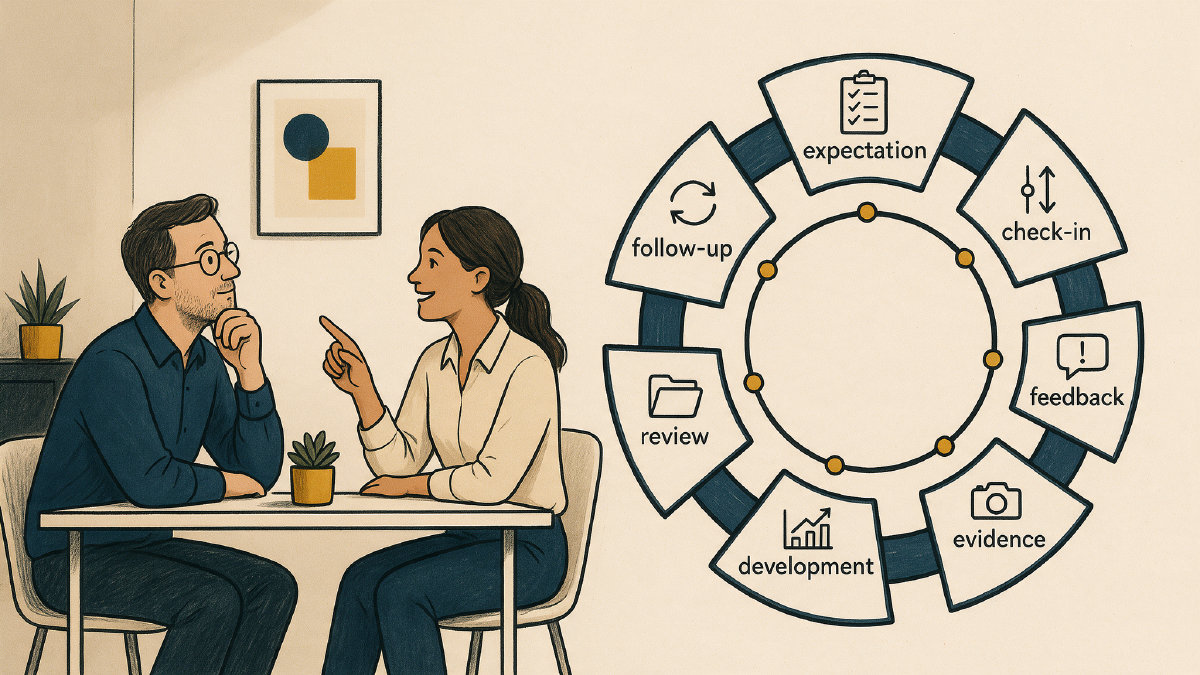
A good manager is always having conversations with direct reports about expectations, progress, and development opportunities. These conversations are usually informal, but they’re still part of a larger process of managing employee performance. In fact, when done well, these conversations become a regular rhythm of communication between managers and employees.
Clarifying Expectations and Goals
Expectations are a key part of performance management. You need to make sure your direct reports understand exactly what is expected of them in terms of their role. That includes both the tasks they have to perform and the behavior they should exhibit. Without clear expectations, it’s impossible to measure performance or provide feedback.
But expectations aren’t just things you tell people once. They’re also things you reinforce through observation and follow-up. When you see someone handling a task or situation in a way that matters to the role, check whether it reflects a defined responsibility or performance standard; if it does, name it and use it to clarify what good work looks like.
When you create expectations for your direct reports, you’re not just telling them what to do. You’re also showing them what to do. Expectations are the foundation of performance management, because they provide a stable target for daily work. If you don’t have clear expectations, your employees won’t know what they’re supposed to be doing.
The first step in creating usable goals is to establish clear expectations. This means communicating what each direct report is expected to do in their role. Expectations should include both the tasks that employees are responsible for completing and the behaviors that they should exhibit.
Once you’ve established expectations, the next step is to create individual objectives for each direct report. Objectives should be specific, measurable, achievable, relevant, and time-bound (SMART). They should also be aligned with the overall goals of the organization.
Objectives should be created in collaboration with direct reports. This ensures that they are realistic and meaningful. Objectives should also be reviewed periodically, so that they stay relevant and achievable.
Creating usable goals involves more than just setting targets. It also involves ensuring that those targets are realistic and achievable. Goals should be aligned with the overall goals of the organization. And they should be reviewed periodically, so that they stay relevant and achievable.
Gathering Performance Data
You need to gather data throughout the year to track progress. This doesn’t mean that you should constantly monitor your direct reports, but it does mean that you should collect some sort of information about their work. This could include metrics such as productivity, quality of work, and timeliness of delivery.
You can also use qualitative data to track progress. This might include observations of how employees interact with one another, or how they handle difficult situations. The key is to gather enough data to allow you to assess whether or not employees are meeting their goals.
You don’t want to turn management into surveillance, but you do want to make sure that you’re gathering enough data to assess whether or not your direct reports are meeting their goals. One practical way to do this is to track your employees’ work using a systematic approach. This could involve tracking their work by recording it in a logbook, or by keeping a record of their accomplishments.
You can also use software tools to track your employees’ work. There are many different types of software available that can help you track your employees’ work. Some of these programs are designed specifically for performance management, while others are more general-purpose. Whatever program you choose, make sure that it allows you to track your employees’ work in a systematic way.
Feedback Check-ins and Evaluations
Ongoing feedback and check-ins are important components of performance management. These are the conversations that managers have with their direct reports about their work. Feedback helps managers reinforce effective performance and correct less-than-desirable performance. Check-ins help managers ensure that employees are meeting their goals and staying on track.
Feedback should be given regularly, and it should focus on the work that employees are doing. Check-ins should also be regular, and they should cover all aspects of employees’ work. Both feedback and check-ins should be based on clear expectations.
Performance evaluations are an important part of performance management. These are formal assessments of employees’ work. Evaluations should be based on clear expectations, and they should provide employees with feedback on their performance. Evaluations should also set new goals for employees.
Evaluations should be conducted regularly, and they should be based on clear expectations. Employees should receive feedback on their performance, and they should be given new goals. Evaluations should also provide employees with opportunities for professional growth.
Coaching and Development Planning
Coaching and development planning are essential parts of performance management. These are the activities that managers engage in to help their direct reports grow professionally. Coaching involves providing employees with guidance and support as they work toward their goals. Development planning involves identifying employees’ professional growth opportunities and helping them develop the skills and knowledge needed to achieve those opportunities.
Coaching and development planning should be conducted regularly, and they should be based on clear expectations. Employees should receive coaching and development planning from their managers. Coaching and development planning should also be based on employees’ individual needs.
Preparation and Closure
Preparation and closure are important parts of performance management. These are the steps that managers take to prepare for performance reviews and to close out the review process. Preparation involves establishing performance-measurement standards, comparing on-the-job performance against those standards, and documenting the results of the review. Closure involves assessing progress, providing feedback, and setting new goals.
Preparation and closure should be conducted regularly, and they should be based on clear expectations. Employees should be prepared for performance reviews by being aware of what is expected of them. Employees should also be aware of what is expected of them during the review process. Preparation and closure should also be based on employees’ individual needs.
Useful Management Behaviors
Useful management behaviors are those that help managers assess, guide, and improve the work of their direct reports. Bureaucratic box-checking is the opposite of this; it’s the practice of following procedures without understanding why they were created. Useful management behaviors are supported by evidence and tied to the needs of the person and work in front of you, while bureaucratic box-checking treats the procedure itself as the point. Direct human conversations are essential for successful performance management, and these conversations should be supported by evidence.
When managers partner with HR, they can avoid the pitfalls of improvisation. HR professionals can provide guidance on how to handle sensitive situations, and they can help managers interpret company policies. However, HR professionals should not be used to improvise on behalf of managers. Instead, managers should partner with HR professionals to ensure that they understand the rules and procedures that govern their organization.
Corrective Action
Corrective action is a type of performance management that is used to address poor performance. Corrective action can be either informal or formal. Informal corrective action is typically used to address minor issues, while formal corrective action is used to address major problems. Corrective action can be used to address a variety of issues, including poor performance, conflicts, and other workplace problems.
Corrective action should be documented, and it should be reviewed periodically. It should also be based on clear expectations. Corrective action should be used to address poor performance, and it should be used to improve the performance of employees who are struggling. Corrective action should also be used to resolve conflicts between employees.